Foundation repair in Morgantown, from the bluff to the river bottoms
Morgantown, the Butler County seat about 30 miles northwest of Bowling Green, stands on a bluff on the west side of the Green River. How high a house sits above the water decides a lot about what its foundation goes through.
The Green River was Morgantown's main road until 1917, and the town grew up on the high ground above it. The courthouse lawn holds one of only two monuments in the country honoring Union and Confederate veterans together. Around that old core, houses spread down the slopes and out into Butler County, and the ground under them changes with every hundred yards of elevation.
Basements are common on sloped lots because the grade makes them easy to build. They are also where we see the slow kind of failure that catches owners by surprise. A block wall holding back wet clay does not give way in a day. It usually goes something like this:
- A wet springThe clay behind the wall soaks up water and swells against the block. A thin horizontal crack shows up in a mortar joint about halfway up.
- The next few yearsEach wet season adds a little. The crack lengthens and the wall begins to lean inward along it. Water may start to seep through.
- When someone noticesA shelf no longer sits flat against the wall, or a stair-step crack runs from the horizontal one out to a corner. Checked with a level, the wall is out of plumb.
- The repairAnchors, steel beams or carbon fiber, depending on how far the wall has moved, plus drainage so the clay behind it stays drier from then on.
Lower on the slopes and nearer the river, crawl spaces and slabs contend more with groundwater and humidity. Up on the bluff it is mostly roof water and the soil right at the footing. We plan the repair around which of those you have.
How we help homeowners in Morgantown
Wall movement measured
Every bowing wall gets plumb readings at several points so the repair matches the movement.
Anchors or beams
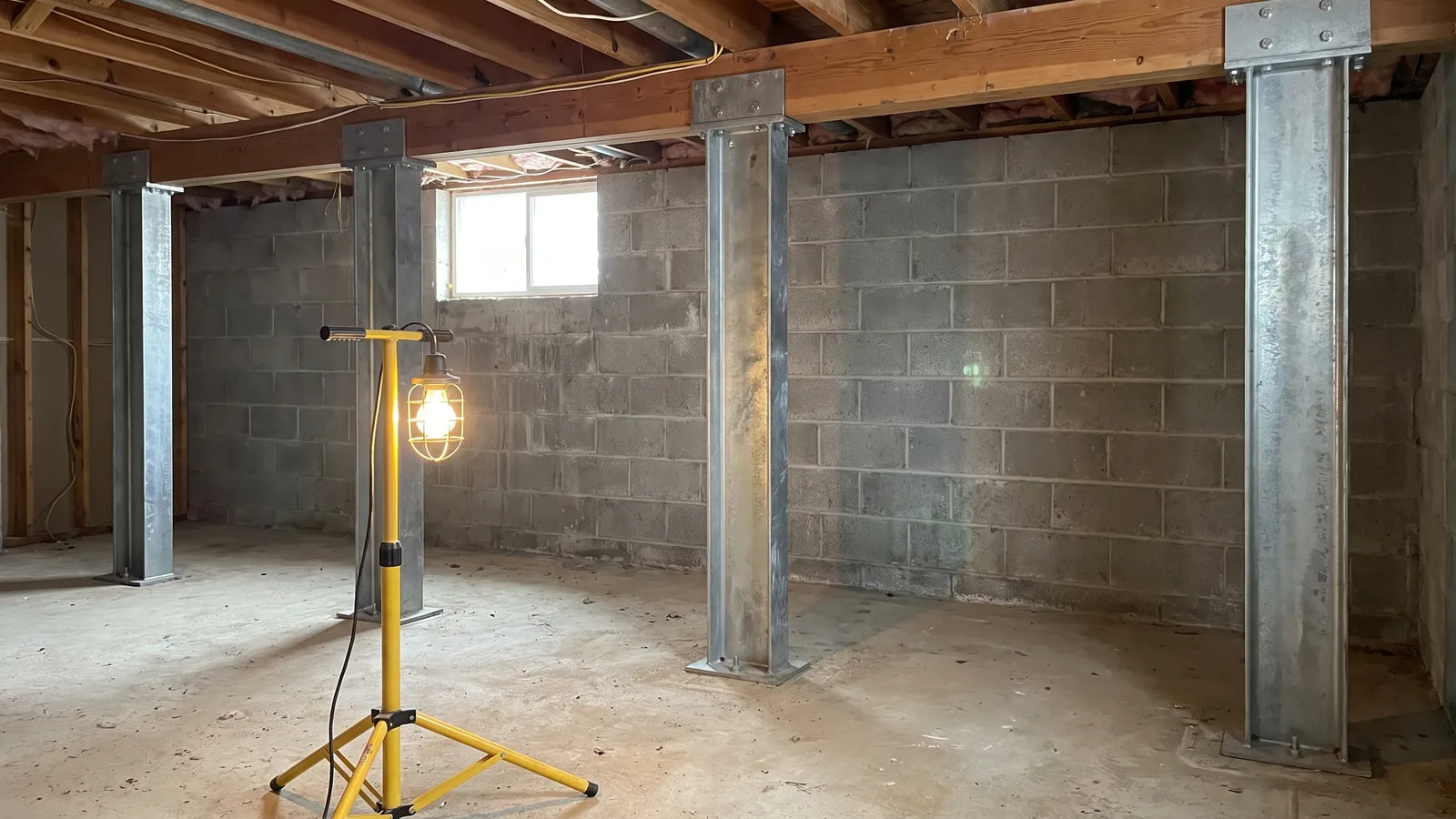
Wall anchors where the yard allows them, steel beams braced to the floor and joists where it does not, carbon fiber for walls that have moved only a little.
Pressure taken off
Interior drains, exterior drains or downspout changes to relieve the water pressure that caused the bow.
Downhill piers
Push or helical piers on the low-side footing when a house on a slope is settling toward the river.
Low-ground crawl spaces
Moisture control and new supports for homes on damp ground near the water.
Butler County paperwork
Permit requirements confirmed for your address, with the 811 locate filed before any digging.
Roads and landmarks around Morgantown
- The courthouse square
- Bluff-top streets above the Green River
- Homes on the slopes toward the river
- Rural Butler County
Repairs we bring to Morgantown
- Under the house: foundation repair, push piers, helical piers, house and floor leveling
- Walls, cracks and slabs: crack repair, bowing basement walls, slab foundations, sinkhole and karst repair
- Crawl spaces: crawl space repair, encapsulation
- Water: basement waterproofing, sump pumps, French drains and yard drainage
- Flatwork and checkups: concrete leveling, free foundation inspection
What people in Morgantown ask before we dig
My basement wall has a horizontal crack. How serious is that?
More serious than a vertical crack, because it usually means soil pressure is pushing the wall inward. Get it measured. A wall that has moved a little costs less to stabilize than one that has moved a lot.
Can a bowed wall be pushed back straight?
Sometimes partly, over time, with anchors tightened in stages. The main aim is to stop further movement. A wall that has gone too far may need rebuilding, and we say so plainly if that is the case.
Why does water come in where the wall is cracked?
The crack is a path, and saturated clay behind the wall pushes water through it. Sealing the crack alone rarely lasts; drainage takes the pressure away.
Is Morgantown inside your area?
Yes, about 30 miles northwest of Bowling Green, and the inspection is free.
Do you work on houses built into a slope?
Often. Sloped lots need water caught uphill and the downhill side watched, and we plan for both.
What does wall repair cost?
Today's Homeowner puts a typical bowing-wall repair at about $2,000 to $7,500, with anchors around $80 to $150 per foot of wall and steel or carbon fiber straps about $85 to $275 per foot. Your exact figure comes after we measure.
Next towns over: Brownsville · Russellville · Smiths Grove · every town we cover